
Wisdom Is Rarely Statistically Probable
From Plato’s warnings about the written word to the modern A.I. gold rush, technology has always threatened to replace deep thought with the mere illusion of knowledge.


A look throughout history shows that we have many times invented tools that helped us externalize our memory from writing to maps and calculators; and, similar to today, people have been worried about the consequences.
In the Phaedrus, Plato (speaking through Socrates) warned that the new technology of writing would weaken memory and offer only the illusion of wisdom.
He recounts an Egyptian myth in which the god Theuth presents writing to King Thamus, claiming it as a "recipe for memory and wisdom." Thamus counters that it will have the exact opposite effect:
“If men learn this, it will implant forgetfulness in their souls; they will cease to exercise memory because they rely on that which is written… What you have discovered is a recipe not for memory, but for reminder.”
Writing, he feared, would make people seem highly knowledgeable while knowing little, leaving them full of "the conceit of wisdom" rather than wisdom itself.
So was Plato right? Did writing weaken our memory?
Yes and no.
Plato was right that writing did reduce the need for individual memorization. Today, we rarely memorize long texts or genealogies "by heart" as pre-literate cultures did.
But he was wrong to treat that as a simple loss. Writing massively expanded our collective memory, freeing up cognitive resources for analysis, coordination, and abstraction.
Societies could now maintain records across centuries and build institutions without depending on flawless oral transmission.
On the societal level, this was the opposite of “forgetfulness.” By moving memory from the individual to the shared record, we democratized knowledge, shifting power from monarchs and clergy into the hands of the public.
This brings us to the present, and begs a critical question: What is the effect of AI on our collective memory? Will it deskill our society, or free up capacities that advance civilization?
To answer this, we cannot just look at AI as a technology itself; but also consider the present paradigm, in which it is built.
At first glance, AI appears to be doing what writing and the printing press did: making knowledge accessible to vastly more people. It can build analogies to previously inaccessible concepts, act as a personalized tutor, and help non-coders vibe code their ways into “artifacts” that would have previously taken an entire agency to build.
But there is an apparent difference between the printed page and a Large Language Model.
A book holds a record, preserving the voice, meaning-making, and context of its author. AI, contrarily, ingests our collective intelligence (in the form of “training data”, and synthesizes it into probabilistic output.
In doing so, it reveals the dominant paradigm of Western technology—one that treats knowledge less as a shared inheritance and more like a to-be-extracted resource.
This extraction changes the power dynamic. When we outsource our collective memory and reasoning to AI, we are not democratizing power as the printing press did; we are actively centralizing it.
We are taking the diverse, messy, polyphonic voices of human history and passing them through the narrow ideological bottlenecks of a few massive tech corporations.
Whose histories are deemed “quality training data,” and whose oral traditions, dialects, and marginalized experiences are filtered out?
In the realm of Big Data, the dominant hegemonic narrative is the statistical majority. Therefore, Indigenous oral traditions, decolonial perspectives, and marginalized ways of knowing are, by sheer mathematical definition, treated as “improbable” anomalies.
If we rely on this as our primary memory apparatus, we risk a new kind of digital colonialism—an epistemic flattening where rich, relational ways of knowing are overwritten by the statistically most probable algorithms.
This epistemic flattening directly answers the question of whether AI will deskill us.
If AI deskills us of the ability to write a rote corporate memo, that is no great loss. But because AI strips knowledge of its relational context, we are at grave risk of deskilling our relational intelligence and our moral imagination.
The very process of writing, thinking, and creating is about grappling with making sense and meaning. By offloading this, we risk becoming a society of editors rather than creators, skimming the surface of statistically probable syntheses without ever diving into the deep waters of independent thought.
And what of the capacities AI supposedly frees up?
The techno-optimist narrative promises that by offloading cognitive labor, we will be freed to pursue higher-level abstraction, art, and leisure. But here, extractive capitalism strikes twice. Just as the current paradigm extracts our collective memory to feed its models, it extracts our “freed-up time” to feed perpetual economic growth.
In How Much Is Enough?, economist Robert Skidelsky and philosopher Edward Skidelsky revisit John Maynard Keynes’s famous 1930 prediction that rising productivity would shrink the working week to fifteen hours.1 Nearing 2030, we can assess his predictions.
In 1929, the average American worked about 2,300 hours a year; today, that figure is roughly 1,800. While this is a significant decline, Keynes’s fifteen-hour week translates to about 750 hours a year. Not even Germany (my home country)—which works fewer hours (1,340) than any OECD country—has gotten halfway there.2
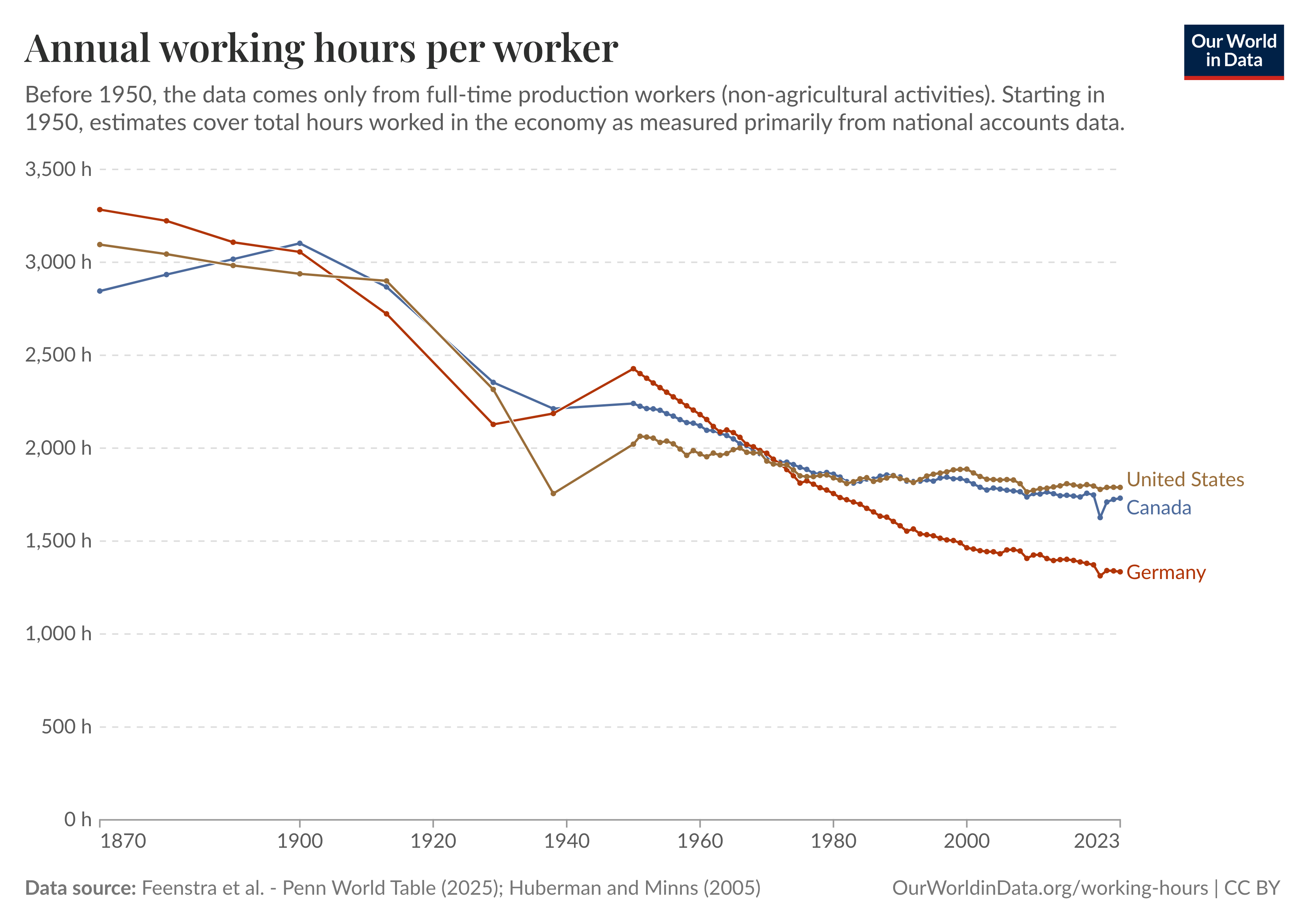
Meanwhile, productivity rose far beyond what Keynes imagined. But the time freed was not returned to humanity. Instead, it was reinvested into more output, more consumption, and more work. The time saved by technology was simply absorbed by an insatiable demand for extraction.
Questioning the paradigm we grew up with—this intrinsic belief that efficiency must inevitably serve extraction—is challenging. But what if we refused this cycle?
What if we used the bandwidth freed up by AI not to produce more information, but to re-skill ourselves in the profoundly human arts? The art of deep listening, of intergenerational care, of earth-stewardship.
What if we shifted our societal value toward a relational epistemology—cultivating wisdom that is rooted in place, community, and lived reality?
Plato was right to warn that technology could create the “conceit of wisdom.” AI amplifies this risk exponentially, offering us the illusion of omniscience without the anchoring weight of human experience.
But we are not trapped. We have the agency—and the collective responsibility—to choose how AI is integrated into our societies, and what forms of intelligence we choose to preserve.
Because the most profound wisdom is rarely the most statistically probable.
We should, of course, treat the broader proposals of this book with discernment. The Skidelskys inherited some of Keynes’s own blind spots: they underestimated the profound pleasure and sense of achievement found in skilled work, and they underrated how innovation creates genuinely non-pathological new wants, such as advanced medicine and communication. Meaningful labor and technological progress are not inherently negative.
Though Germany’s current government is legislating Keynes prophecy further away, moving to dismantle the eight-hour workday—a right secured in 1918—allowing single shifts to stretch up to thirteen hours. Chancellor Friedrich Merz recently stated that prosperity cannot be maintained "with a four-day week and work-life balance."
👏👏👏❤️
This is a powerful distinction: technology can expand access to knowledge while simultaneously weakening the conditions required for wisdom.
The real risk is not simply that AI gives us answers. It is that it can remove us from the struggle through which judgment is formed, which is the process of taking a position, testing it against reality, receiving feedback, and refining our understanding. When we become passive editors of statistically probable output, we may appear more knowledgeable while becoming less capable of independent thought.