


I used to think downloading a highly-rated, pre-made Anki deck was a shortcut to mastering a new subject.
Instead, it was a recipe for frustration. I would spend my mornings staring at vague questions, trying to memorize disjointed facts that had nothing to do with my actual goals, and eventually, I would just quit. I was putting in the effort, but I was treating my brain like a storage unit rather than an active processor.
Here is the truth about digital flashcards: downloading someone else’s deck is like wearing someone else’s glasses. Even if the prescription is strong, it’s not designed for your eyes.
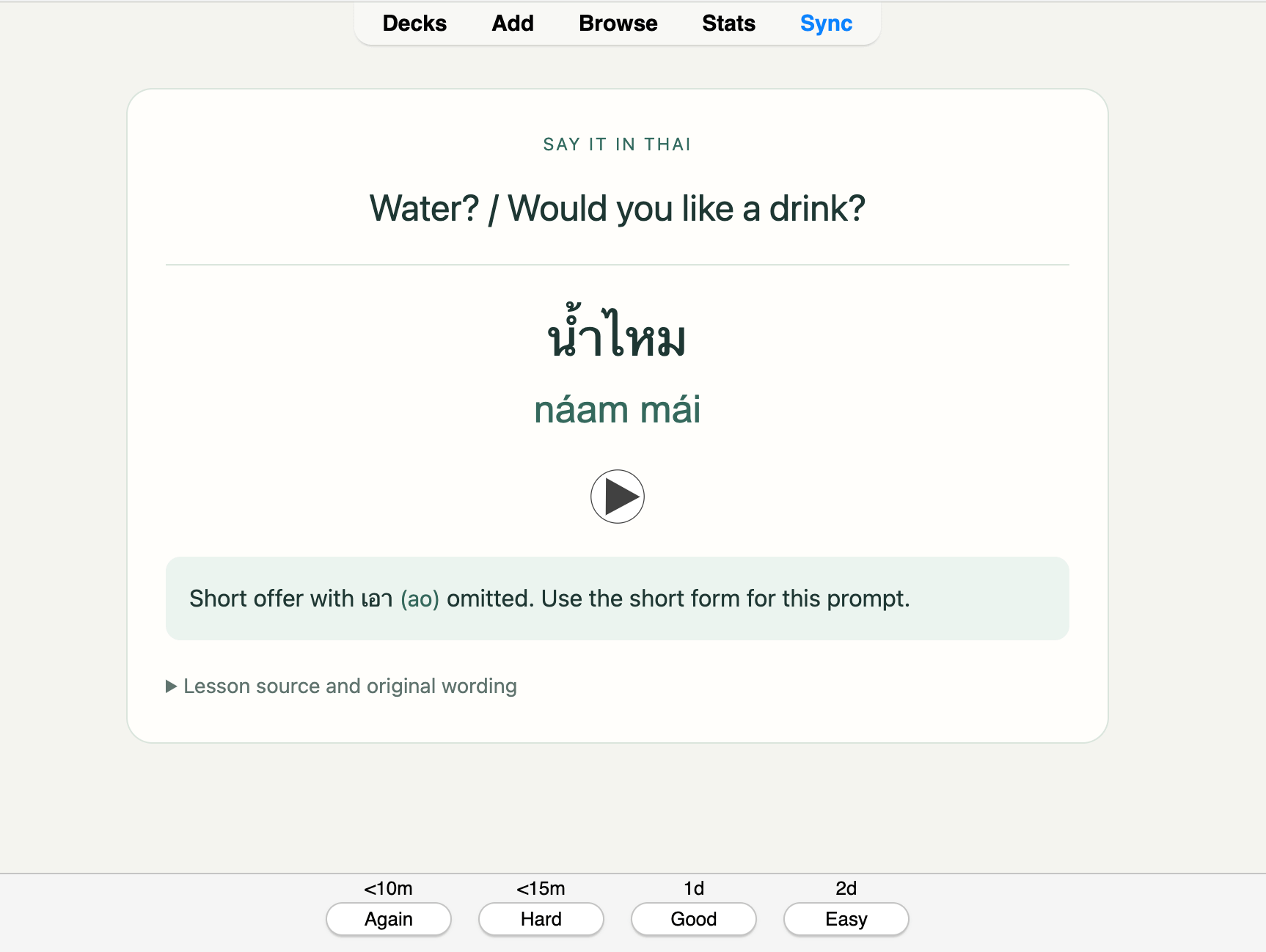
Today, we are looking at a brilliant way to fix this. AI is now advanced enough that you can use it to effortlessly create your own highly-tailored flashcards based on your specific input materials. I recently used this exact method to build a high-quality deck for my Thai lessons—one that adapts weekly based on the exact vocabulary and grammar I need to know.
But there is a catch. If you just ask AI to “make flashcards,” it will generate the same ineffective, vague questions you find in public decks.
In the Lifelong Learning Club, our goal is always to use AI to augment thinking, instead of outsourcing it. In the next few minutes, you’ll learn exactly why most flashcards fail, and how to use learning science to instruct AI to build a deck you actually want to use.
Here is how to stop wasting time on bad flashcards and start enhancing your cognition.
The Two Traps of Public (and poorly prompted) Decks
There are thousands of public Anki decks out there1, but to be honest, many decks I’ve tried have suffered from two problems.
First, most of the time, the questions are too unspecific, which leads to cognitive overload. Here’s what I mean by that.
Yesterday, I read an article by the Nobel Prize-winning economist Paul Krugman. He dismantled one of the reasons for rising inequality. An idea that I want to remember from that article is that extreme wealth leads to extreme political power (via campaign contributions and lobbying). The hyper-wealthy use this power to change public policy in their favor (like cutting their own taxes), which generates even more wealth, creating a self-reinforcing downward spiral that undermines democratic accountability.
If I used that idea to make a flashcard, the two sides would look like this:
Front — Question: According to Paul Krugman (2026), how can hyper wealth and political power reinforce each other?
Back — Answer: Hyper wealth can fund political campaigns and lobbying. The resulting influence can help secure policies that increase that wealth. (Source: Paul Krugman “Oligarchy and the Great Evasion” Substack Article Aug 30 2026).
Do you notice how the question I chose is very specific? “What was Krugman’s article about?” is a recipe for cognitive overload. With a question that vague, you are asking your limited working memory to rummage through a massive pile of everything you’ve just read. A focused question provides a more useful retrieval cue: a prompt connected specifically to the knowledge you’re trying to bring back to mind. By asking a targeted question about a particular idea, you provide a precise mental hook. You are highlighting a paved path in your long-term memory, giving your brain a clear, paved path to follow rather than leaving it to wander lost in the woods.
Second, someone else’s deck is built around someone else’s learning goals.
Even well-written questions are useless if they have little connection to what you want to understand, use, or talk about. As Anki practitioner Bjornstad writes, “It’s a terrible shame to waste it learning things you don’t care about.”
Furthermore, there is a hidden learning opportunity in making the cards. In five out of six experiments, researchers found that people who created their own digital flashcards learned more than those who studied ready-made ones (Pan et al.). The act of creation engages learning processes that help you actively synthesize the material.2
That’s why I recommend a hybrid approach: let AI draft the cards, but you act as the editor. Start with material you’ve already engaged with, let AI generate the deck, and then ruthlessly check them: Do I understand the answer? Is the question clear? Do I actually want to remember this?
Your life is busy enough. Nothing is more of a time-waste than a flashcard deck that feels tedious. Every single card must earn its place.
What Should You Put in Your Deck?
A deck could hold concepts you want to think with—like mental models, biases, or quotes. It might contain knowledge you need for a professional certification, negotiation techniques you want to recall when discussing your fee, or ideas from books you want to draw on when making decisions.
It could also hold facts that help you identify the world around you (birds, plants, mushrooms, art, landmarks), practical procedures you use frequently (software shortcuts, checklists), or simply people’s names and a poem you’d love to know by heart.
I currently have a deck for learning the Thai language, one for the greatest works of art, one for music production, and one for recognizing trees. Yours will look completely different. Ultimately, a good candidate for your deck is simply anything you’d be glad to remember at a particular moment.
How to Set Up Your AI-Powered Deck with ChatGPT-6 Astra
If the idea of building an AI-powered flashcard deck sounds a little daunting, please don’t worry. It truly isn’t. You don’t need any special technical skills or hours of free time to make this work.
Once you understand the basic framework, the process takes just a few minutes, and it can seamlessly become a natural, rewarding part of your reading routine.
Here is the simple, three-step practice to get your deck set up.
1) Choose what to practise, what to save, and what to let go
Before we even open ChatGPT, we need to choose what is actually worth remembering. The key reason why people quit using flashcards is because what they try to remember is irrelevant. If it feels irrelevant, the practice becomes tedious rather than exciting.
From the start, we want to focus on creating a habit that is meaningful for you. Here are three principles to help you decide what to keep whenever you finish a passage.
Practise what you want to remember when it matters. Ask yourself: “When would I be glad to have this in my head?” Perhaps you come across a question in a book you want to use: “Would you like me to listen, or help you think this through?” Having that question available during a conversation could help you respond differently. That gives you a reason to practise recalling it. Your reason can also come from simple curiosity. Look for something you want to understand, do, or experience that remembering could help with.
Save what you mainly need to find again. Ask yourself: “Would being able to look this up be enough?” A recipe’s quantities or a recommended book’s title might belong here. Put them somewhere you already keep useful notes, with enough context to recognise what they are. You don’t need a new app or an elaborate filing system to begin; you just don’t need them cluttering your flashcards.
Let go when the reading itself was enough. Ask yourself: “Am I happy to have read this, even if I never return to it?” Yesterday, I read a poem by Maria Popova that touched my soul. I enjoyed the experience, and I don’t intend to memorise it. A passage can make you laugh, keep you company, or help you see something differently. You can enjoy that without turning it into another task.
For this workflow, I currently recommend GPT-6 Astra.

2) Give AI the card-writing guide and your source material
Once you’ve chosen the ideas you want to keep, we can invite AI to help turn them into practice cards. To do this well, we need to explain what a good card looks like.
In a 2026 analysis of nearly 400,000 Claude sessions, Anthropic found that greater task knowledge was associated with higher AI success rates. Its methodological appendix describes expertise through behaviours such as specifying relevant constraints, knowing what to check, and correcting substantive errors. Hence for creating Anki cards, we want to clearly articulate constraints and instructions.
To help you do that, I’ve put my learning-science knowledge and three years of Anki practice into a guide you can give to your AI assistant. It includes precise card-writing instructions, 18 worked examples showing weak cards and how to improve them, and an annotated source guide for further reading.