
How to Use Deliberate Practice to Get Better at What You Do
A simple framework to improve instead of maintain.


I spent ten years going to the gym without getting stronger.
If you’ve been doing something for years—teaching, managing, writing, coding—and you're still struggling with the same things you struggled with two years ago, this is for you. In the next few minutes, you’ll learn a simple way to tell whether you’re improving, and what to change if you’re not.
Here’s how I learned it the slow way.
At eighteen, I joined a gym. I remember the fluorescent lights and the smell of disinfectant. I strolled past intimidating-looking machines, studying each one for something that looked doable, and chose the yoga mat. I then wandered to the cardio area for ten half-hearted minutes on the stepper.
I was in my discipline era, and I repeated that pattern for a decade. Sometimes four times a week, sometimes once. Always “showing up”, always without a clear plan.
I copied what the strong people were doing—trying a machine here, a squat there—without knowing what I was trying to improve or how I’d measure it. I told myself I just needed more time. (Hello, 10,000-hour rule.)
It didn’t work.
On good days, I left feeling slightly better in my body. On bad days, I spiraled into: you’re just not a sports person. Most days, I carried a low-grade frustration I couldn’t name. I was putting in effort, but I couldn’t point to a single thing I was getting better at.
Eventually, accumulated frustration cracked my ‘I don’t want to ask for help’ ego and I hired a personal trainer.1
In the first session she did three things I hadn’t done in ten years: she picked a concrete target, watched me closely, and corrected me while I was doing the rep. For the first time, I had direction and feedback.
Within months, my results changed—because my practice changed.2
This article isn’t about the gym.
It’s about the same trap in professional life: doing the thing for years, getting more experienced, and staying stuck at the same level. You can work hard for a very long time without getting better—not because you’re lazy or untalented, but because you’re confusing practice with deliberate practice.
When Experience Stops Turning Into Expertise
Here’s the tell that you’re stuck: if someone asked you, “What are you better at than six months ago?” and you can’t answer with something concrete, you’re probably on autopilot.
Writer and memory champion Joshua Foer calls this experience the OK Plateau — the point where you’ve automated a skill enough to stop improving.Psychologists Fitts and Posner described the same shift as the autonomous stage of learning: you can do the thing without thinking about the thing.
You see it everywhere once you know what to look for. The teacher with twenty years in the classroom who teaches the same way she did in year two. The manager who’s been “leading teams” for a decade but still dreads difficult conversations. The writer who publishes every week but whose craft hasn’t changed since the first essay.
As a former teacher turned education researcher, I've visited classrooms across nine countries, from Estonia to the Philippines.3 Whether on formal learning exchanges or simply asking local principals for a conversation while traveling, I saw a similar pattern: Many veteran teachers, deeply committed to their students, were carrying enormous workloads — planning lessons, managing classrooms, navigating bureaucracy, supporting families — with almost no time or structure built in for their own growth. The system asked them to perform, not to practice: more students, more paperwork, more accountability; but rarely a coach, a peer observation, or space to try a new approach and get feedback on it. While teachers’ dedication never wavered, the conditions for improvement weren’t there.
While experience accumulated, expertise didn’t have a chance to.
Ten years in a job doesn’t mean ten years of improvement. For most of us, it’s more like this: you improved for the first year or two, then you got efficient and stayed there. More comfortable, more reliable, but not more skilled.
Our brains are wired for this. There’s a well-documented tendency called the principle of least effort: the brain automates repeated tasks to conserve cognitive resources. That’s useful when you’re learning to drive or type. But it also means that once a skill feels “good enough,” your brain stops actively working to improve it. You shift from effortful learning to autopilot without noticing.
As psychologist K. Anders Ericsson writes: “This distinction between deliberate practice aimed at a particular goal and generic practice is crucial because not every type of practice leads to improved ability.”
My gym years were generic practice. Showing up, going through the motions, getting a tiny dopamine hit from the effort, then going home. The teachers I observed were doing the same thing, just in a classroom instead of a weight room. It’s a similar pattern, in a different domain.
So if repetition alone doesn’t make you better, what does?
The Goal of Deliberate Practice
Deliberate practice is not “working harder.” It’s not grinding more hours. It’s a specific, structured method for trading energy for skill. And it’s the only reliable way to break through the OK Plateau.
The simplest distinction: regular practice is maintenance. Deliberate practice is growth.
Going for a jog to stay fit is regular practice. Running structured interval sessions to run faster at your 10K race deliberate practice. Playing through your favorite songs on guitar is regular practice. Isolating the chord transition you keep fumbling and drilling it for twenty minutes is deliberate practice.
The authors of Make It Stick, put it cleanly: deliberate practice is “goal-directed, often solitary, and consists of repeated striving to reach beyond your current level of performance.”
That “reaching beyond” part is key. Think of three zones:
Comfort Zone: What you already know how to do. Safe, automatic, no growth happening here.
Learning Zone: Just a bit beyond your current ability. Challenging but manageable. This is where deliberate practice lives.
Panic Zone: Too far beyond your ability. Leads to overwhelm and anxiety. No learning here either.
One thing I want to be clear about: not every practice needs to be deliberate. You can pick up a guitar just to play. You can dance without a plan. You can sketch for the pleasure of sketching. Hobbies without goals can be a genuine source of joy — and I’d argue they should be.
But if you’re stuck, and you actually want to get better at something that matters to you, keep these four pillars in mind.
The Pillars of Practice that Improve Performance
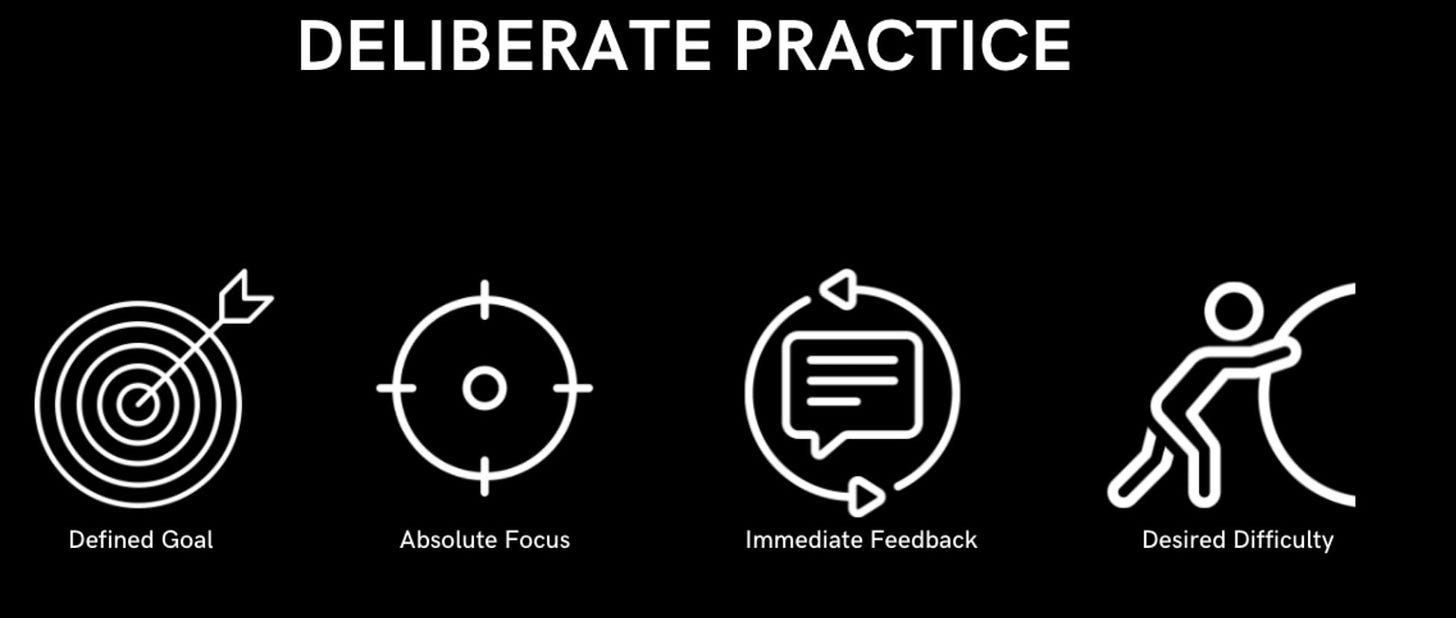
1. Break the skill into micro-skills you can drill and measure.
“Get better at writing” is not a goal you can practice. “Write clearer opening sentences” is. “Become a better manager” is vague. “Give specific, actionable feedback in one-on-ones” is trainable.
A useful rule: name the skill like a takeaway, not a topic. If your practice target sounds like “Sales 101,” it’s probably too fuzzy. If it sounds like “Good sales is about asking good questions,” you can actually train it.
You need to identify the smallest testable component of the skill you care about, then drill that one thing until it’s solid before moving on. In the gym, I didn’t “get stronger” — I first learned the deadlift form. Then I added weight. Then I added reps.
Ericsson’s research on expert performers across chess, music, and surgery consistently found the same pattern: experts break complex skills into micro-components and practice them in isolation. Whereas novices practice the whole thing at once and wonder why they’re not improving.
How to apply this: Pick one skill you’re working on. Write down three sub-skills it requires. Choose the one you’re weakest at. That’s your practice target for the next two weeks.
2. Protect 45 minutes of phone-off, distraction-free deep practice.
You can’t do deliberate practice for eight hours. Ericsson found that even world-class performers top out at roughly four hours of sustained deliberate effort per day. Hence, forty-five minutes of focused, phone-off intensity beats a full day of half-distracted “work.”
I’ve written before about rebuilding my focus. The core insight is the same here: deep practice requires protecting a block of time the way you’d protect a meeting with someone important. No email, no notifications, no “quick check” of anything.
When I started training with my personal trainer, we had a fixed slot. Sixty minutes, no phone, full attention on form and load. That structure did more for me than years of wandering through the gym whenever I felt like it.
How to apply this: Block 45 minutes this week. One micro-skill. Phone outside the room. Decide the drill before you start. Treat it like the most important meeting on your calendar.
3. Build a fast feedback loop (before mistakes become habits).
Here’s a line I wish someone had told me at eighteen: practice doesn’t make perfect. Practice makes permanent. If you practice a deadlift with bad form, you’re cementing bad form. If you rehearse a presentation with a weak opening, you’re getting better at delivering a weak opening.
You need a feedback mechanism that shows you, in close to real time, what you’re doing wrong. A coach. A recording. A test. A score. Something that creates a correction loop before the mistake becomes a habit.
My trainer was this for me — she’d adjust my grip, my stance, my breathing, while I was doing the rep. That’s feedback with zero delay. And it’s the reason I progressed in weeks what I hadn’t in years.
The important tweak: avoid opinion feedback when you can get reality feedback. “So what did you think?” is usually just fishing for compliments. Instead, get close to the work: have someone watch you, or have them walk you through what they did and where they got stuck. You want insights into what happened, not vibes about your performance.
Not every domain makes this easy. If you’re learning a language, apps like Lingvist or a speaking pal on iTalki can give you correction. If you’re learning to write, publishing and reading the comments is a (sometimes brutal) feedback loop. If you’re learning to code, the compiler tells you when you’re wrong.4
But some domains don’t give you clean feedback at all. I’ll come back to this — because it’s where things get really interesting.
How to apply this: For the skill you’re working on, ask: how quickly do I find out if I’m doing it right or wrong? If the answer is “weeks” or “months” or “I don’t know,” you need to engineer a faster loop. Record yourself. Find a coach. Build a test. Replace “what did you think?” with “what happened when you tried it?”
4. Set difficulty so you fail ~15% and stay in the learning zone.
If it feels easy, you’re in maintenance mode. If it feels impossible, you’re in the panic zone. Deliberate practice lives in the uncomfortable middle, where you fail roughly 15% of the time — a figure from research on optimal learning rates, though the evidence comes primarily from simpler tasks.
In the gym, I know I’m in the right zone when the last two reps of a set feel genuinely hard. Not impossible, but demanding enough that I have to focus completely. If I breeze through every set, the weight is too light and I’m not growing. If I can’t complete a single rep with decent form, I’ve gone too far.
The same applies outside the gym. If you’re practising a presentation and it feels smooth, raise the stakes — record it, or deliver it to someone who’ll interrupt you at the first confusing moment. If you’re studying a subject and the material feels easy, you’re reviewing, not learning. Find the edge where you start to struggle.
How to apply this: Think about your last practice session — whatever skill you’re working on. Were you comfortable the whole time? If yes, you weren’t practising deliberately. Next time, adjust the difficulty until you’re failing around one in six to seven attempts while still staying in good form.
What To Do in Wicked Environments (when feedback is slow, noisy, or misleading)
Everything I’ve described so far assumes that the domain you’re practicing in actually gives you feedback you can learn from.
In chess, you know within minutes if your move was good or bad. In surgery, you see the outcome on the table. In language learning, a native speaker’s confused face tells you immediately that something didn’t land. Decision scientist Robin Hogarth calls these “kind” learning environments — the feedback is clear, timely, and tied to your actions. Deliberate practice works naturally here.
But many of the domains that matter most in professional life are wicked.
In investing, you decide and the feedback arrives months or years later; buried in noise, distorted by factors unrelated to your reasoning. In management, you give feedback to a team member and don’t know for weeks whether it changed anything. In strategy and policy-making, outcomes unfold over years, shaped by forces far beyond your analysis.
In wicked environments, you can gain confidence without gaining skill. You feel like you’re improving — your experience grows, your conviction strengthens — while your actual judgment stays flat. Or worsens. This is the most dangerous plateau, because you can’t feel it happening.
So what do you do when the environment won’t teach you? You build your own feedback system. You engineer the loops wicked domains don’t provide naturally.
One practical way to do that: shrink the loop. Break big, slow outcomes into faster-resolving sub-predictions, write them down before you act, and score them afterward. Keep a simple decision journal: what you believed, what you did, what you expected to happen, and what actually happened. Over time, you’re no longer “getting experience.” You’re training calibration.
This is exactly what Mauricio from Polymath Investor shares in an upcoming guest post on Wednesday. He shows how to decompose investment decisions into faster-resolving sub-predictions, how to use calibration tools like Brier scores to measure your actual skill, and how to separate what you learned from what you got lucky on.
If you work in any domain where the feedback is slow, noisy, or misleading — and that includes most knowledge work — his piece will be a relevant guide.
A Simple Deliberate-practice Plan You Can Repeat
I spent ten years waiting for the gym to magically make me stronger. It didn't start working until I asked a different question — not "am I showing up?" but "am I getting better, and how would I know?"
That question made me stop conflating effort with progress, and get honest about the difference.
If you take one thing from this piece, make it this: pick one skill that matters to you right now, and find the smallest sub-skill you can actually practice this week. Not "become a better communicator" — something small enough to drill and specific enough to measure.
Then protect forty-five minutes for it, the way you'd protect a meeting you couldn't cancel. Decide what "better" looks like before you start, not after. Build a feedback loop tight enough that you're not spending weeks perfecting the wrong thing. And push just past comfortable. If it feels easy, you're maintaining; if it's impossible, you're panicking. Learning happens in the slightly uncomfortable middle.
That's it. Four moves, repeated. It's not complicated; but it does require the one thing generic practice never asks of you: the willingness to be bad at something on purpose, in a focused way, for long enough that your brain has no choice but to adapt.
And yes — sometimes the feedback loop is the hardest part to build. If you're working in a domain where feedback is slow, noisy, or misleading, Wednesday's guest post from Mauricio will walk you through that.
Sources
Bjork, E. L., & Bjork, R. A. (2011). Creating desirable difficulties to enhance learning. In Psychology and the Real World: Essays Illustrating Fundamental Contributions to Society, 56–64.
Brown, P. C., Roediger, H. L., III, & McDaniel, M. A. (2014). Make it stick: The science of successful learning. Harvard University Press.
Campitelli, G., & Gobet, F. (2011). Deliberate practice: Necessary but not sufficient. Current Directions in Psychological Science, 20(5), 280–285.
Ericsson, K. A. (2008). Deliberate practice and acquisition of expert performance: A general overview. Academic Emergency Medicine, 15(11), 988–994.
Ericsson, K. A., Krampe, R. T., & Tesch-Römer, C. (1993). The role of deliberate practice in the acquisition of expert performance. Psychological Review, 100(3), 363–406.
Hogarth, R. M. (2001). Educating Intuition. University of Chicago Press.
Miller, S. D., Chow, D., Wampold, B. E., Hubble, M. A., Del Re, A. C., Maeschalck, C., & Bargmann, S. (2020). To be or not to be (an expert)? Revisiting the role of deliberate practice in improving performance. High Ability Studies, 31(1), 5–15.
It would take me another year until I found the right YouTube video (evidence-based; there's so much bad fitness advice for women) and the right personal trainer for me (who was also a yoga teacher and could speak my language of tuning into the body rather than treating it like a robot).
I learned to deadlift with clean form, then tracked whether I could add weight or reps week to week. I learned building cardio didn’t mean random all-out spin sessions; it meant spending far more time in zone 2 and only pushing high intensity once a week. I learned to read my body and that feeling weaker some days before my period was part of a very healthy cycle, and ignoring it meant sickness, injury, or burnout. Within months, I had results that a decade of wandering never led to. And the self-belief that I can learn things if I apply the right approach. Last autumn, I trail-ran my first half marathon through the Vienna woods and I now deadlift 90kg and leg-press 160kg for reps.
See, for example, 3 Things I Learned from the Country with Europe’s Best Schools. These field notes were republished by Education Estonia, the official international education initiative of the Estonian government.
AI adds a twist here. Fluent AI-generated drafts (of code, writing, and other pieces of “knowledge work”) create a fluency illusion. But you don’t build judgment unless you add friction. I argue in this piece that you still need some hands-on production to understand how things fail—but the grind moves from drafting to deconstruction and critique.
I love this, I think one angle remaining potentially is the angle of exploration, how one can use exploration as part of gaining mastery, changing things a bit, seeing the outcome updating the mental model. This also helps in making sure you remain agile over time. Would love to hear your thoughts on this
Dein Artikel kommt für mich genau zur richtigen Zeit! Das Konzept von Deliberate Practice lernte ich zum ersten Mal in "So good they can't ignore you" von Cal Newport kennen.
Ich nehme mir deine Tipps zu Herzen und werde gleich morgen 45 Minuten einplanen, um ein meinem Sub-Skill zu arbeiten noch bessere Überschriften zu schreiben. Ich merke, dass ich beim Schreiben lernen wirklich weit außerhalb meiner Komfortzone bin und ich hoffe, dass herunterbrechen auf Sub-Skills macht es für mich leichter handhabbar. Danke!